



How AI Analytics Tools Help Businesses Make Better Marketing Decisions
In today’s digital marketplace, businesses are flooded with data. Website traffic, user behavior, conversion rates, and campaign performance generate a constant stream of information. While this data holds the key to unlocking growth, many business owners find themselves overwhelmed, struggling to translate raw numbers into a coherent strategy. The good news is that a new generation of artificial intelligence (AI) is transforming this challenge into an opportunity. Modern AI-powered analytics tools for marketers are designed to sift through the noise, uncover hidden patterns, and deliver the actionable insights you need to make smarter, faster, and more profitable decisions.
From Data Overload to Actionable Insights: The AI Revolution in Analytics
For years, digital analytics meant manually exporting data into spreadsheets, spending hours trying to connect dots, and making educated guesses about customer behavior. This traditional approach is not only time-consuming but also prone to human error and bias. It often results in looking backward at what has already happened, rather than forward to what might happen next.
AI-powered analytics flips this model on its head. Instead of just collecting data, these intelligent systems actively analyze it in real-time. They use machine learning algorithms to identify significant trends, detect anomalies that a human might miss, and even predict future outcomes with a surprising degree of accuracy. For a business owner, this means shifting from reactive problem-solving to proactive strategy. You can anticipate customer needs, identify potential issues before they escalate, and allocate your marketing budget with confidence, knowing your decisions are backed by data, not just intuition.
Core Features of AI-Driven Analytics Platforms
While features vary between platforms, most leading-edge AI analytics solutions share a set of powerful capabilities that set them apart from their traditional counterparts. Understanding these features helps you see the practical value they can bring to your marketing efforts.
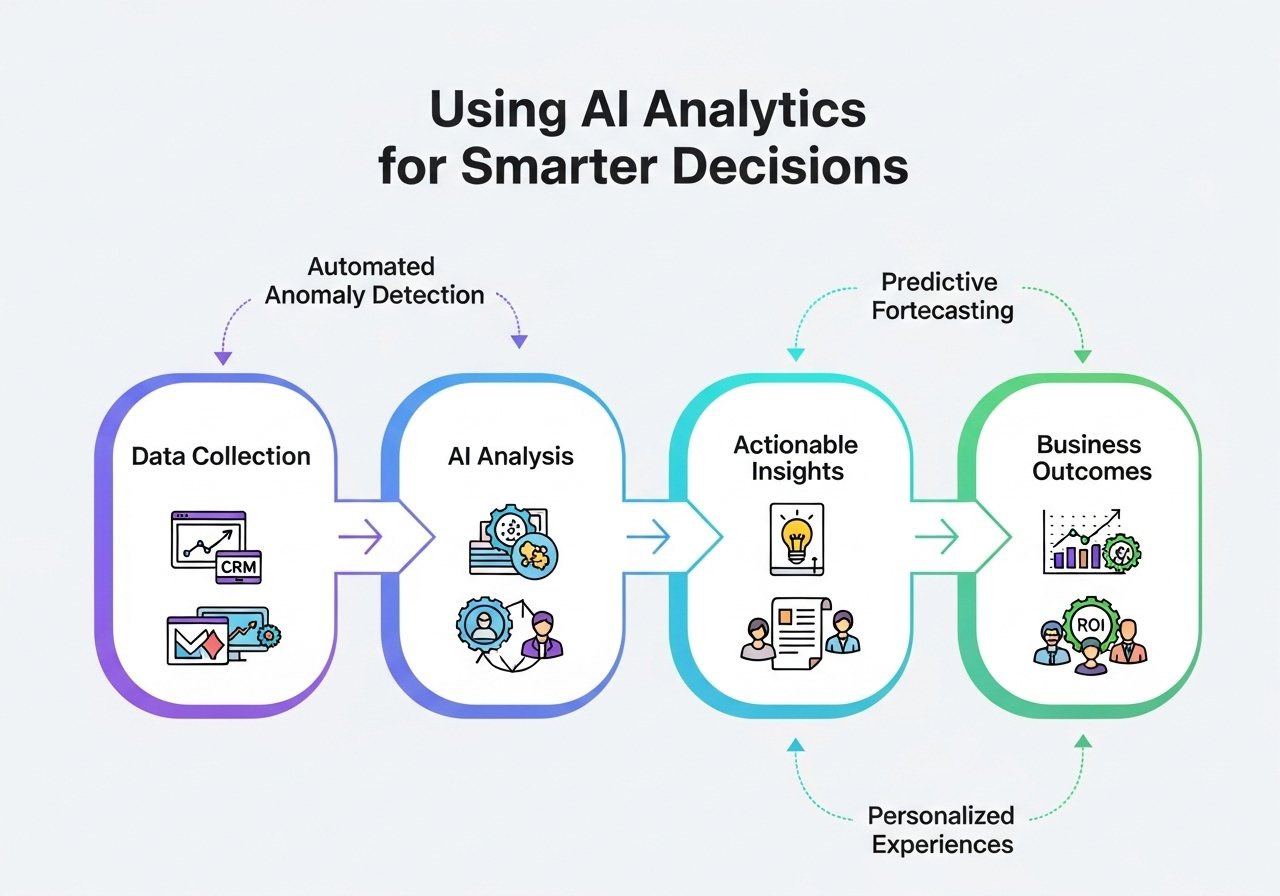
- Predictive Analytics: This is perhaps the most game-changing feature. AI algorithms can analyze historical data to forecast future trends, such as which customers are most likely to make a purchase, which users are at risk of churning, or the potential lifetime value of a new customer segment. For example, Google Analytics 4 uses this to create ‘Predictive Audiences’ you can target with ad campaigns.
- Automated Anomaly Detection: Did your website traffic suddenly drop by 30% on a Tuesday morning? Or did a specific product’s sales unexpectedly spike? AI systems monitor your key metrics 24/7 and automatically alert you to statistically significant changes, allowing you to investigate opportunities or fix problems immediately.
- Natural Language Processing (NLP): The barrier between you and your data is disappearing. With NLP, you can ask questions in plain English, such as « Which landing pages had the highest conversion rate last month for users from Canada? » and receive an instant, easy-to-understand answer, report, or chart.
- Intelligent Segmentation: Instead of manually creating audience segments based on simple demographics, AI can automatically group users based on complex behaviors and predictive traits. This allows for hyper-targeted personalization and more effective marketing campaigns.
Practical Applications to Boost Your Marketing ROI
Theory is great, but how does AI analytics translate into tangible business results? By leveraging these tools, you can make data-driven decisions across your entire marketing funnel to improve efficiency and drive growth.
Here’s a comparison of how AI changes the game:
| Marketing Task | Traditional Approach | AI-Powered Approach |
|---|---|---|
| Budget Allocation | Based on last-click attribution and historical performance. | Recommends budget shifts in real-time based on predictive ROI and multi-touch attribution models. |
| Content Strategy | Analyze popular posts and guess what might work next. | Identifies content gaps and predicts which topics will resonate with high-value audience segments. |
| Customer Personalization | Broad segmentation based on demographics (e.g., age, location). | Hyper-personalization based on predicted user intent, behavior, and likelihood to convert. |
| Conversion Rate Optimization (CRO) | Manual A/B testing based on hypotheses. | Identifies points of friction in the user journey and suggests high-impact test variations automatically. |
Selecting the Best AI Analytics Tools for Marketers and Business Owners
The market for AI analytics tools is expanding rapidly. While platforms like Google Analytics 4 offer powerful AI features for free, other specialized tools may offer deeper insights for specific industries or use cases. When choosing a solution, don’t just chase the most advanced technology. Instead, focus on what aligns with your business needs.
Consider the following factors:
- Business Goals: What specific questions do you need to answer? Are you focused on lead generation, eCommerce sales, or user engagement? Your goals will determine which features are most important.
- Integration: The best tool is one that works with your existing technology stack. Ensure it can easily connect to your website platform (like WordPress), CRM, email marketing service, and advertising platforms.
- Usability: A powerful tool is useless if your team can’t use it. Look for an intuitive interface, clear visualizations, and features like natural language queries that lower the technical barrier to entry.
- Scalability and Support: Choose a solution that can grow with your business. Furthermore, assess the level of customer support and training resources available. If you need expert help implementing a robust analytics strategy, the team at Digimek is ready to assist. Contact us today to ensure your analytics are set up for success.
Frequently Asked Questions
Do I need to be a data scientist to use AI analytics tools?
No. Modern AI analytics platforms are increasingly designed for business users, marketers, and entrepreneurs. Features like automated dashboards, anomaly alerts, and natural language queries are specifically built to provide powerful insights without requiring you to write code or have a background in statistics.
What is the main difference between AI analytics and standard Google Analytics?
Standard analytics primarily focuses on descriptive reporting—it tells you *what* happened (e.g., you had 10,000 visitors last month). AI-powered analytics adds diagnostic and predictive layers. It helps explain *why* it happened (e.g., a traffic spike was due to a social media mention) and predicts *what will* happen next (e.g., which visitors are likely to convert).
Is AI analytics expensive for a small business?
It doesn’t have to be. Many powerful AI features are already integrated into free platforms like Google Analytics 4. For businesses needing more advanced capabilities, many SaaS providers offer tiered pricing plans that can scale with your needs, making it an accessible investment for companies of all sizes.
Embracing AI in your analytics isn’t about replacing human intuition; it’s about augmenting it with powerful, data-driven evidence. By leveraging the right **analytics tools for marketers**, you can move beyond guesswork and build a marketing strategy that is more efficient, effective, and attuned to the needs of your customers. The future of marketing is intelligent, and it’s more accessible than ever.
