



AI Analytics Advisors: 5 Ways to Maximize Your Data Insights
In the fast-paced world of digital marketing, data is king. But collecting data is only the first step; the real challenge lies in transforming raw numbers into actionable insights. This is where AI analytics advisors are becoming game-changers. These intelligent systems, often built into platforms like Google Analytics 4, can sift through massive datasets to uncover trends, anomalies, and opportunities that might otherwise go unnoticed. However, treating them like a magic button is a recipe for disappointment. The true power is unlocked through effective collaboration.
Learning how to work with these AI tools—how to question them, guide them, and interpret their findings—is the key to elevating your marketing strategy. It’s not about replacing human experts but augmenting their capabilities. This guide outlines 5 ways to collaborate with AI analytics advisors to make smarter decisions and drive sustainable growth for your business.
1. Establish Clear Business Objectives and KPIs
Before you can ask an AI analytics advisor for meaningful insights, you must first define what success looks like for your business. An AI tool without direction is like a ship without a rudder; it can process a lot of information but has no destination. Start by defining your core business objectives. Are you trying to increase online sales, generate more qualified leads, improve customer retention, or boost brand awareness?
Once your objectives are clear, translate them into specific, measurable Key Performance Indicators (KPIs). For example:
- Objective: Increase online sales. KPIs: Conversion rate, average order value, cart abandonment rate.
- Objective: Generate more qualified leads. KPIs: Form submission rate, cost per lead, lead-to-customer ratio.
- Objective: Improve customer retention. KPIs: Customer lifetime value (CLV), churn rate, repeat purchase rate.
With these defined goals and KPIs, you can direct your AI advisor to look for relevant information. You can ask questions like, « What marketing channel contributed to the highest conversion rate last month? » or « Which user segment has the highest customer lifetime value? » This focused approach ensures the insights you receive are directly tied to your business goals, preventing you from getting lost in a sea of irrelevant data.
2. Master the Art of Conversational Prompting
Interacting with modern AI analytics advisors is becoming increasingly conversational. Think of the AI as a very fast, but very literal, junior analyst. It needs clear, specific instructions to provide valuable output. Vague questions like « How’s my website doing? » will yield generic, unhelpful answers. The key is to master conversational prompting.
Be specific in your requests. Instead of asking about general traffic, ask, « Compare organic search traffic from mobile users in the US this quarter versus last quarter. » Provide context where possible. For instance, « We launched a new ad campaign on May 1st. What was the impact on new user acquisition from social media in the two weeks following the launch? »
Don’t be afraid to ask follow-up questions to dig deeper. If the AI identifies a drop in traffic from a specific source, your next prompt could be, « Which specific landing pages saw the biggest decrease in traffic from that source? » This iterative process of questioning and refining helps you peel back the layers of your data to uncover the root cause of trends.
3. Validate AI-Generated Insights with Human Expertise
AI is incredibly powerful at identifying correlations and patterns at a scale no human could match. It can tell you *what* happened. However, it often struggles to explain *why* it happened. This is where human expertise and business context are irreplaceable. An AI might notice a correlation between ice cream sales and website traffic, but a human analyst knows this is likely due to a summer marketing campaign, not a causal relationship.
Always treat AI-generated insights as hypotheses, not as absolute truths. Use your industry knowledge and understanding of your business operations to validate them. Does the insight make sense in the context of recent market changes, competitor actions, or internal business decisions? This partnership between machine-speed pattern recognition and human-led contextual analysis is where the most profound discoveries are made.
| Capability | AI Analytics Advisor | Human Expert (e.g., Digimek) |
|---|---|---|
| Data Processing Speed | Processes millions of data points in seconds. | Slower, methodical analysis of curated data sets. |
| Pattern Recognition | Excellent at finding statistical correlations and anomalies. | Good at recognizing patterns within a business context. |
| Contextual Understanding | Limited; lacks real-world business and market context. | Excellent; understands the ‘why’ behind the data. |
| Creative Strategy | Cannot develop novel marketing strategies. | Develops creative, strategic plans based on insights. |
| Bias Detection | Can inherit biases from its training data. | Can identify and correct for data and cognitive biases. |
4. Use AI Recommendations to Fuel A/B Testing and Optimization
One of the most valuable outputs from an AI analytics advisor is predictive recommendations. The system might suggest that users from a certain demographic are more likely to convert if shown a specific type of offer, or that a particular landing page could perform better with a different call-to-action.
Instead of implementing these suggestions blindly, use them as the foundation for a structured A/B testing program. An AI’s recommendation is a data-backed hypothesis. For example:
- AI Insight: « Users who view video content on product pages have a 30% higher conversion rate. »
- Hypothesis: « Adding a product demonstration video to our top 5 product pages will increase the overall conversion rate. »
- Action: Run an A/B test where 50% of visitors see the page with the video (variant) and 50% see the original page (control).
By testing these AI-driven hypotheses, you can scientifically validate their impact before rolling them out across your entire website. This approach minimizes risk and ensures that the changes you make are genuinely improving performance, leading to a robust conversion rate optimization (CRO) strategy.
5. Integrate AI Insights into a Continuous Improvement Loop
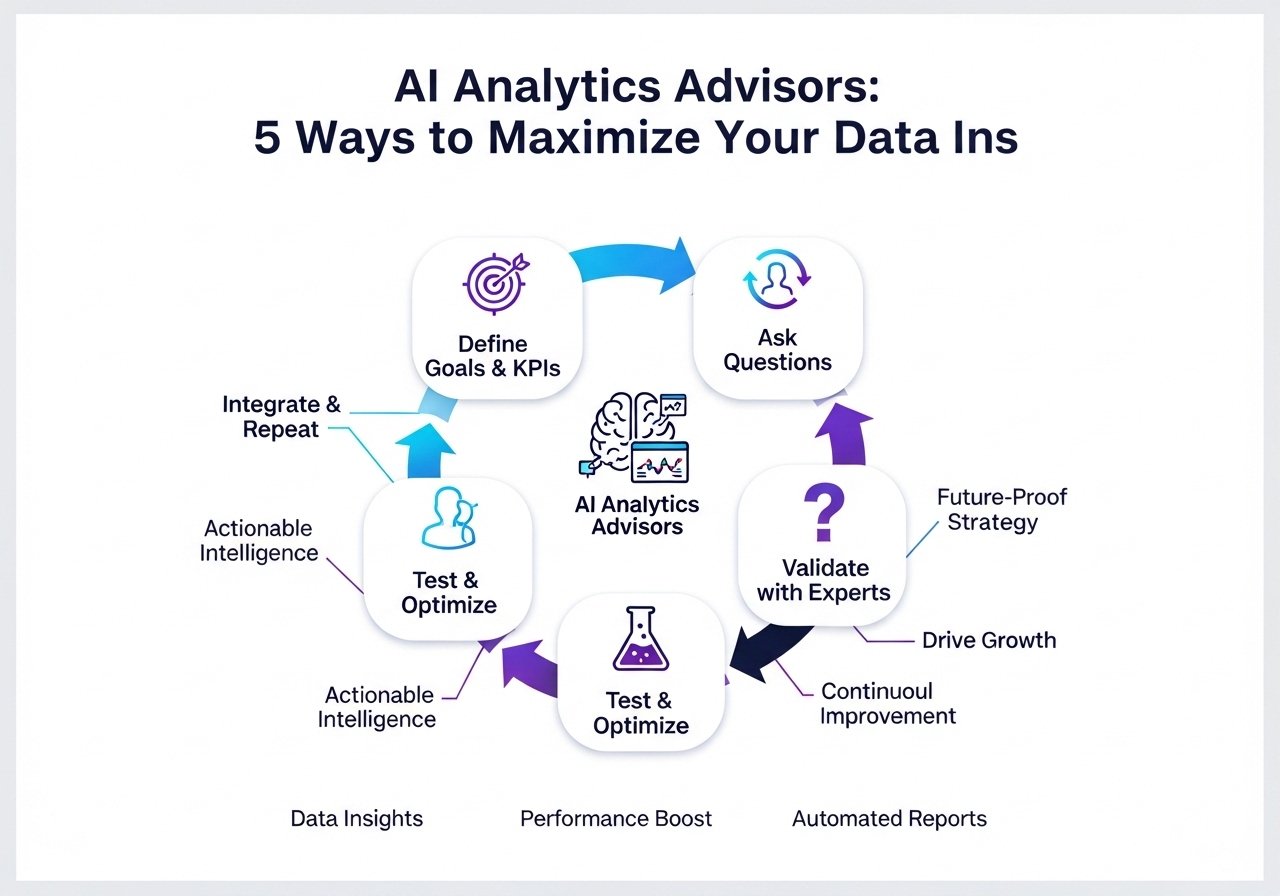
Collaboration with AI analytics advisors should not be a one-time event. To truly harness its power, you must integrate it into a continuous cycle of improvement. This process, often known as a feedback loop, involves a recurring workflow: Define, Analyze, Act, and Measure.
- Define: Start with your business objectives and KPIs.
- Analyze: Use the AI advisor to ask targeted questions and uncover insights related to your goals. Validate these findings with human expertise.
- Act: Turn the validated insights into action. This could mean launching a new marketing campaign, optimizing a landing page, or personalizing the user experience.
- Measure: Use your analytics platform to track the impact of your actions on your KPIs.
The results from the ‘Measure’ phase then feed back into the ‘Define’ and ‘Analyze’ phases of the next cycle. Did the changes have the expected impact? What new questions have emerged? This continuous loop ensures your marketing efforts are constantly evolving and improving based on fresh, relevant data, creating a powerful engine for growth.
Frequently Asked Questions
What are AI analytics advisors?
AI analytics advisors are intelligent software features, often integrated into platforms like Google Analytics, that use machine learning to automatically analyze data. They can identify significant trends, provide predictive insights, and answer questions about your data in natural language, helping businesses make more informed decisions.
Can AI replace my human analytics team?
No, AI is a tool to augment, not replace, human experts. AI excels at processing data and identifying patterns (‘the what’), while humans provide the crucial business context, strategic thinking, and creative problem-solving to understand ‘the why’ and decide on the best course of action.
How do I get started with AI in my analytics?
Start by ensuring your analytics platform, like GA4, is properly configured to collect high-quality data. Then, begin exploring the built-in AI features, such as the ‘Ask Analytics’ search bar. Focus on asking specific questions tied to your business goals and KPIs to get the most relevant insights.
What are the limitations of AI-powered analytics?
The primary limitations include a lack of real-world business context, the inability to understand causation (only correlation), and the potential for inheriting biases from training data. Insights should always be critically reviewed and validated by a human expert before action is taken.
Effectively collaborating with AI analytics advisors is a skill that will become increasingly vital for digital success. By setting clear goals, asking smart questions, validating insights, and integrating them into a continuous improvement cycle, you can transform your data from a passive resource into an active driver of growth. If you need help setting up your analytics for success or want an expert partner to help interpret what the data is telling you, Digimek is here to help. Contact us today to start a conversation about your data strategy.
