



Crafting a Winning Digital Marketing Strategy for Business Growth
In today’s competitive online landscape, simply having a website and a social media profile isn’t enough to guarantee growth. Businesses poised for expansion need a clear, actionable roadmap to navigate the digital world, attract the right customers, and drive revenue. This roadmap is your digital marketing strategy. It’s the crucial framework that aligns your marketing efforts with your core business objectives, ensuring every dollar and every hour spent contributes directly to your bottom line.
Without a cohesive strategy, marketing activities can become fragmented, inefficient, and difficult to measure. You might be posting on social media, running ads, and sending emails, but are they working together to achieve a common goal? This guide will walk you through the essential steps to build a robust digital marketing strategy that fuels sustainable growth for your business.
Understanding the Core Components of a Digital Strategy
A successful strategy is built on a solid foundation. Before diving into specific tactics, you must define the fundamental pillars that will guide your decisions. These components ensure your marketing is targeted, purposeful, and aligned with your brand.
- Target Audience Definition: Who are you trying to reach? Go beyond basic demographics. Create detailed buyer personas that include pain points, motivations, online behavior, and preferred communication channels. The more you understand your ideal customer, the more effectively you can tailor your messaging.
- Business Objectives & KPIs: What does success look like for your business? Your marketing goals should be a direct reflection of your overall business objectives, whether it’s increasing sales by 20%, generating 50 new qualified leads per month, or boosting customer lifetime value. Key Performance Indicators (KPIs) are the specific metrics you’ll use to track progress toward these goals.
- Brand Positioning & Messaging: What makes you unique? Define your unique value proposition (UVP) and the core messages you want to communicate. Your brand voice—be it professional, friendly, or technical—should be consistent across all channels.
- Competitive Analysis: Analyze what your competitors are doing online. Identify their strengths, weaknesses, and the channels they are using successfully. This analysis can reveal gaps in the market and opportunities for you to stand out.
Setting SMART Goals for Measurable Success
Vague goals like « increase website traffic » are impossible to measure and lead to wasted effort. To create a truly effective digital marketing strategy, your objectives must be SMART: Specific, Measurable, Achievable, Relevant, and Time-bound. This framework transforms broad ambitions into actionable targets. For more on goal setting, resources like MindTools provide excellent guidance.
Here’s how to differentiate between a vague goal and a SMART goal:
| Vague Goal | SMART Goal | Breakdown |
|---|---|---|
| Get more leads. | Increase marketing qualified leads (MQLs) from organic search by 25% in the next quarter. | S: MQLs from organic search. M: 25% increase. A: Assumes current baseline allows for growth. R: Directly supports sales growth. T: Next quarter. |
| Improve social media. | Grow LinkedIn follower count by 500 new followers and achieve a 5% average engagement rate on posts within 60 days. | S: LinkedIn followers and engagement rate. M: 500 followers, 5% rate. A: A challenging but attainable target. R: Builds brand authority in a B2B context. T: 60 days. |
| Rank higher on Google. | Achieve a top-5 ranking on Google for the keyword « local business IT support » within 6 months. | S: Top-5 ranking for a specific keyword. M: Position 1-5. A: Depends on competition and SEO effort. R: Drives highly relevant traffic. T: 6 months. |
Choosing the Right Digital Marketing Channels
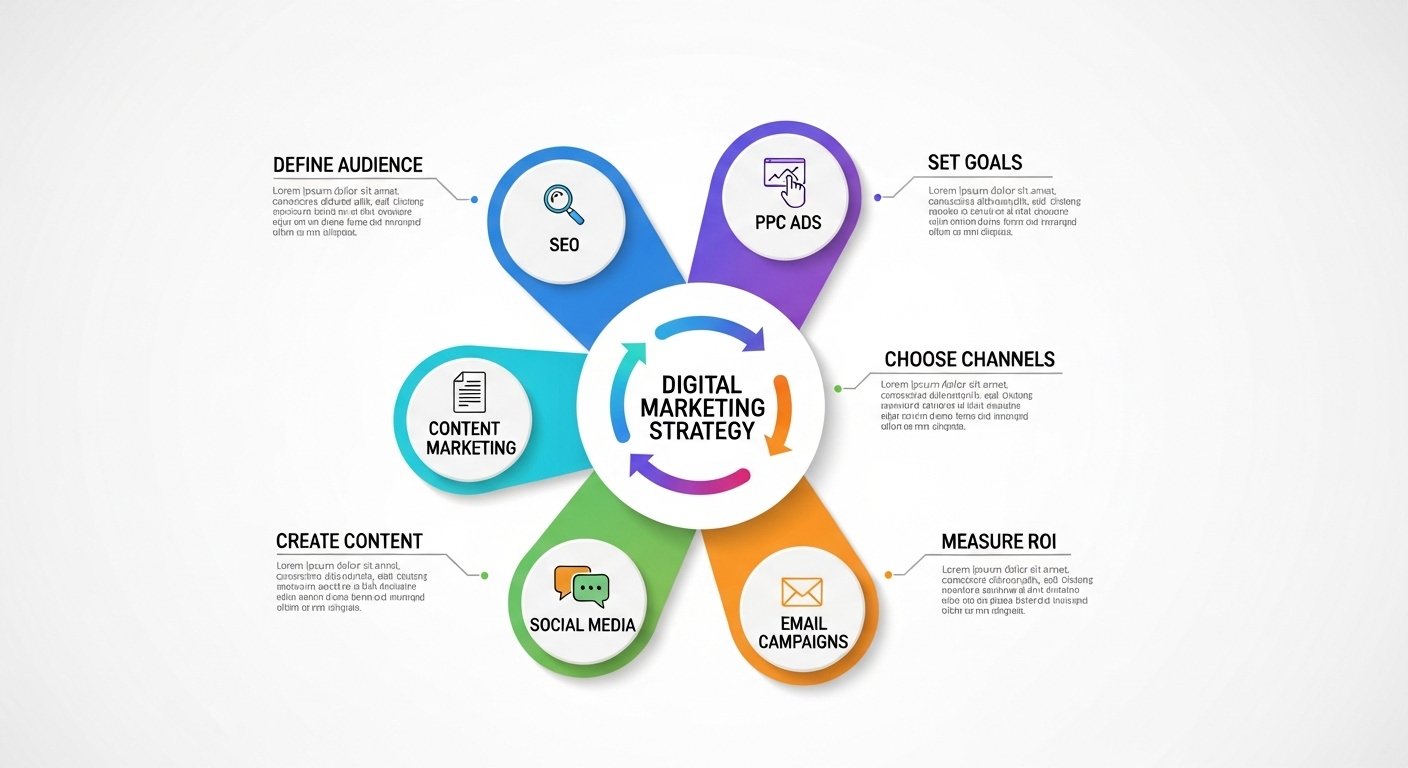
Not all digital marketing channels are created equal, and a growing business shouldn’t try to be everywhere at once. The key is to select the platforms where your target audience is most active and that align with your SMART goals. Focus your resources on 2-3 core channels to start, and expand as you grow.
- Search Engine Optimization (SEO): The foundation for long-term organic growth. SEO focuses on optimizing your website to rank higher in search engine results for relevant queries, driving consistent, high-intent traffic.
- Content Marketing: Creating and distributing valuable, relevant content (blogs, videos, case studies) to attract and retain a clearly defined audience. According to Mailchimp, it’s about building trust and authority.
- Pay-Per-Click (PPC) Advertising: Running ads on platforms like Google Ads or social media. PPC offers immediate visibility and is highly measurable, making it ideal for lead generation and sales campaigns.
- Social Media Marketing: Building a community, engaging with customers, and driving brand awareness on platforms like LinkedIn, Facebook, Instagram, or X (formerly Twitter). The choice of platform depends entirely on your audience.
- Email Marketing: Nurturing leads and retaining customers through targeted email campaigns. It remains one of the channels with the highest ROI, perfect for building direct relationships with your audience.
Developing a Content Plan That Converts
Content is the fuel for your digital marketing engine. A strategic content plan ensures you are creating assets that speak to your audience at every stage of their journey, from initial awareness to the final purchase decision. This is often visualized as a funnel:
- Top of Funnel (Awareness): The goal here is to attract a broad audience and introduce them to your brand. Content types include blog posts, infographics, social media updates, and short videos that address common problems or questions.
- Middle of Funnel (Consideration): At this stage, your audience is evaluating solutions. Provide more in-depth content that showcases your expertise and helps them make an informed decision. Examples include case studies, white papers, webinars, and detailed guides.
- Bottom of Funnel (Decision): Here, you need to convince prospects that your solution is the best choice. Content includes free trials, demos, consultations, customer testimonials, and detailed product comparisons.
Measuring Success and Optimizing for Performance
A strategy is not a « set it and forget it » document. The final, and perhaps most critical, step is to continuously measure your performance against your KPIs and optimize your approach. Tools like Google Analytics are indispensable for this process. Key metrics to track, as highlighted by Google’s own documentation, include:
- Traffic & Engagement Metrics: Website sessions, users, bounce rate, and time on page.
- Conversion Metrics: Conversion rate, cost per lead (CPL), and number of form submissions or sales.
- Channel-Specific Metrics: Organic search rankings (SEO), click-through rate (PPC), and engagement rate (Social Media).
- Revenue Metrics: Return on Investment (ROI) and Customer Lifetime Value (CLV).
Regularly review these metrics in a monthly or quarterly report. Use the insights to double down on what’s working and adjust or eliminate what isn’t. This iterative process of measuring, learning, and optimizing is what turns a good digital marketing strategy into a great one. With digital marketing trends constantly evolving, as shown by recent industry statistics, agility is key.
Frequently Asked Questions
How much should a growing business spend on digital marketing?
There’s no single answer, but a common benchmark is 7-12% of total revenue. However, a new or rapidly growing business might invest a higher percentage to gain market share. The budget should be based on your SMART goals and the cost of the channels you choose.
How long does it take to see results from a digital marketing strategy?
It varies by channel. PPC campaigns can generate traffic and leads within days. SEO and content marketing are long-term investments, often taking 4-6 months to show significant traction but providing more sustainable, compounding returns over time.
What is the single most important part of a digital marketing strategy?
While all components are interconnected, a deep understanding of your target audience is arguably the most critical. If you don’t know who you’re talking to, their needs, and where to find them, even the most well-funded campaign will fail to resonate.
Building and executing a comprehensive digital marketing strategy requires expertise, time, and consistent effort. If you’re ready to accelerate your growth but need a professional partner to guide the way, Digimek is here to help. We specialize in creating data-driven strategies that deliver tangible results. Ready to turn your business goals into a reality? Contact Digimek today for a consultation and let’s build your growth plan together.
